
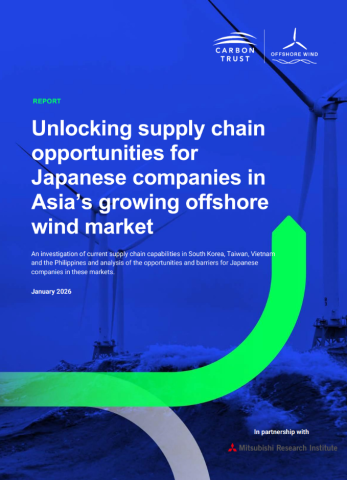
This report analyses the emerging offshore wind supply chain across key Asian markets and assesses how Japan’s industrial strengths can support regional deployment. It provides clear recommendations to enable Japanese suppliers to expand and compete effectively as offshore wind demand accelerates across the Asia Pacific region.
Overview
Growing offshore wind ambition across Asia Pacific is increasing demand for highquality components and services. This report evaluates supply chain maturity in South Korea, Taiwan, Vietnam and the Philippines, identifying areas where domestic capabilities have yet to be developed, and where Japanese companies are positioned to play a pivotal role as offshore wind deployment accelerates.
While each market is at a different stage of readiness, all are expected to face future requirements for substructures, mooring systems, export cables and HVDC substations. Japan’s strengths in advanced manufacturing, materials and electrical systems align closely with these anticipated needs. However, to fully realise its potential contribution to regional offshore wind growth, Japan will require targeted policy support, improved cost competitiveness and stronger cross-market collaboration.
Key findings
- Rapid offshore wind growth across Asia Pacific is expected to place significant pressure on regional supply chains, with potential gaps emerging in areas such as floating substructures, mooring systems, dynamic cables and HVDC substations.
- South Korea, alongside Japan, has the most advanced domestic industrial capabilities, while Taiwan, Vietnam and the Philippines remain reliant on imports for many major offshore wind components.
- Japan’s engineering and manufacturing strengths, including steel fabrication, highquality mooring systems and advanced cable technologies, closely match regional market needs.
- Cost competitiveness and differing standards remains important considerations for Japanese suppliers entering other Asian markets, particularly as regional competition intensifies.
- A limited domestic track record in Japan could constrain future export potential, underscoring the importance of a clear and stable offshore wind pipeline supported by government measures to unlock long‑term investment. In this context, government support and regulatory clarity will be essential to enable investment in facilities, R&D and workforce development.
- Regional collaboration opportunities could reduce supply bottlenecks, enhance knowledge sharing and strengthen supply chain resilience across Asia Pacific.
Download the report here:
Unlocking supply chain opportunities for Japanese companies in Asia’s growing offshore wind market