UK and Germany now share a common goal: to rapidly accelerate
the development and deployment of offshore wind energy to help
their respective countries deliver energy security and meet agreed
carbon reduction plans.
The recent Renewables Road Map put the UK goal at up to 18GW by
2020, while Chancellor Angela Merkel has committed Germany to
building 25GW of offshore wind capacity over the next 20 years, as
part of the country's nuclear energy exit strategy.
Between the two countries, there are now objectives and plans to
deploy over 40GW of new capacity, equivalent to some 8,000
turbines, over the next twenty years. This will not be an easy
challenge and Germany and the UK would do well to recognise they
have a lot to learn from each other. A new partnership to
collaborate and co-operate must be forged to ensure that our
respective resources are developed as quickly and as cost
efficiently as possible.
After all it will be German and UK consumers that ultimately
foot the bill. We owe it to them to keep the cost down.
Analyses carried out by the Carbon Trust over the past five
years, show innovation can dramatically reduce costs. Opportunities
lie across the offshore wind energy supply chain, through to the
deployment and operation of the thousands of offshore turbines that
will be built as far as 290 kilometres from the coast. Our Offshore
Wind Accelerator R&D programme aims to reduce costs by at
least 10 per cent.
Wind turbines: new foundations needed
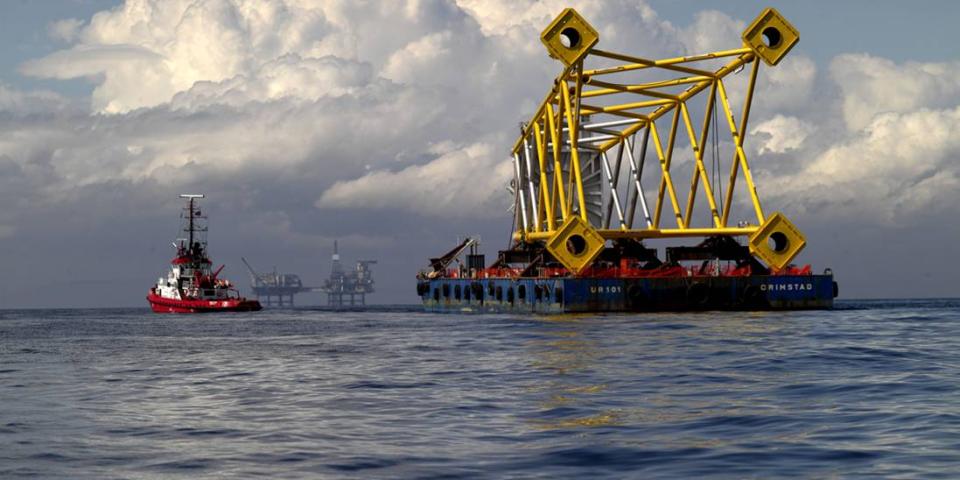
One area where innovation is critical is in turbine foundation
design. Of the wind farms built off the UK coast in the next ten
years, 70 per cent will be in water over 30 metres deep, and some
will need to cope with depths in excess of 60 metres. German
developers face similar challenges. The traditional monopole design
becomes very costly in deep waters. Equally, different subsea soil
conditions mean there is no 'one size fits all' answer: a range of
new technologies is needed.
In addition, optimising the layout of wind farms is becoming
increasingly important as farms get larger, and increased
turbulence is created by the turbine blades. The biggest wind farms
today have about 300 turbines, but Dogger Bank, a site that is due
to be developed in the middle of the North Sea, could have as many
as 2,500. It is critical that the wind farm layout is optimised to
maximise electricity generation.
Next generation wind farms
The next generation of wind farms, built further offshore where
conditions are harsher, will also pose problems in transferring
engineers and equipment safely from boats to wind turbines. This
becomes very challenging 300 kilometres from the coastline, in
turbulent sea conditions. New technology must be developed and
adapted, but dealing with this problem could boost the economics of
offshore wind by as much as £3 billion in the UK alone.
Through work already undertaken with eight wind farm developers,
including the German companies E.ON and RWE Innogy, the Carbon
Trust is helping to find answers to these problems. But this kind
of industry collaboration could go further and faster by combining
UK and German knowledge and resources.
The UK is already the largest generator of offshore wind
electricity in the world, and the focus is now on developing the
next phase, the vast 'Round Three' wind farm sites, at lowest cost.
Combining this knowledge with Germany's renowned engineering
abilities through a new industrial partnership would ensure lessons
learned on both sides of the North Sea are put to best use.
By working together and innovating together, we can ensure
offshore wind becomes a genuine asset, delivering enormous economic
and environmental benefits for both countries.
Read more about the Carbon Trust Offshore
Wind Accelerator